 Makerdao
Makerdao vaults tie Dai debt to locked collateral and liquidation rules
Updated onMakerdao vaults hold approved collateral and record the Dai debt generated against it in the Multi-Collateral Dai system. Stability Fees accrue on outstanding borrowing, and liquidation rules constrain withdrawals. Maker became Sky in 2024; these debt positions differ from newer Sky Vaults, which accept stablecoins for lending strategies.
Collateral and Recorded Debt
Depositing approved collateral gives a vault the capacity to generate Dai within the rules for its collateral type. Drawing Dai increases debt while the collateral stays locked, so the owner retains exposure to its price. A deposit by itself creates no Dai borrowing obligation; generating Dai creates the balance the owner must eventually repay.
Separate Collateral Types
Each regular crypto vault holds a particular collateral type. Different assets need separate vaults, each with its own collateral and debt record. The protocol therefore does not treat a wallet’s entire holdings as one pool of security. Governance decisions determine accepted collateral and the conditions for generating new debt. New Dai borrowing must fit within both the collateral type’s debt ceiling and the system-wide ceiling, even when the vault has sufficient collateral.
Collateral and Debt Balances
The vault records its deposited collateral and outstanding Dai debt as separate balances. Changes in asset prices affect collateral value, while repayment reduces debt. Accrued Stability Fees change the amount owed even when the owner draws no additional Dai.
Stability Fees and Liquidation Ratios
The Stability Fee governs debt growth, while the Liquidation Ratio sets the collateral-to-debt boundary for a vault type.
Debt Growth From the Stability Fee
The Stability Fee accrues on the outstanding Dai debt in a regular Dai vault. The applicable rate can change through governance, so an earlier rate does not establish future borrowing costs. The fee belongs to the debt position; depositing collateral does not turn the vault into a savings product.
The Liquidation Threshold
The Liquidation Ratio measures required collateral value against debt valued at Dai’s target price. Different vault types can use different ratios. A ratio above the threshold provides headroom, which can shrink as collateral prices fall or fees increase debt. The threshold is a liquidation boundary, not a promise that an auction will recover every amount owed.
How Does a Vault’s Collateral Ratio Change?
A vault’s collateral ratio changes when the value of its deposited asset or its outstanding debt changes. An unchanged token quantity can therefore support a different amount of borrowing as prices and fees move.
An Unchanged Deposit With a Changing Margin
Consider a hypothetical regular crypto vault whose owner wants to understand the headroom behind an unchanged deposit. Assume collateral worth $18,764, total debt of 8,137 Dai including accrued fees, and a Liquidation Ratio of 154%.
Using Dai’s $1 target price for debt valuation, the collateral ratio equals $18,764 divided by $8,137, or approximately 230.6%. The threshold collateral value is $8,137 multiplied by 1.54, which equals $12,530.98.
The collateral valuation exceeds that threshold by $6,233.02 at these assumed values. A lower oracle valuation reduces this margin. Additional fee accrual increases the threshold because the calculation uses total outstanding debt, while repayment lowers it. This headroom describes collateral coverage; it is not a withdrawable dollar cash balance.
What Must Be Repaid Before All Collateral Can Be Withdrawn?
Withdrawing all collateral requires full repayment of outstanding Dai debt, including accrued Stability Fees. A partial withdrawal can leave a debt balance, provided the remaining collateral meets the vault type’s requirements.
Network gas pays for transaction execution. It does not repay the vault’s debt.
Repaying Dai reduces the obligation; withdrawing collateral removes assets from the vault. The amount required for a complete payoff includes fees accrued up to repayment. The protocol rejects a partial repayment that would leave nonzero debt below the collateral type’s debt floor.
Having Dai in the wallet does not itself reduce vault debt. The repayment must update the vault’s recorded debt; moving Dai between wallets does not clear that obligation.
Oracle Prices and Liquidation Auctions
A crypto vault becomes vulnerable to liquidation when its collateral valuation no longer satisfies the required collateral-to-debt ratio. The protocol relies on oracle inputs for that valuation, so a price on an exchange can differ from the price currently applied to the position.
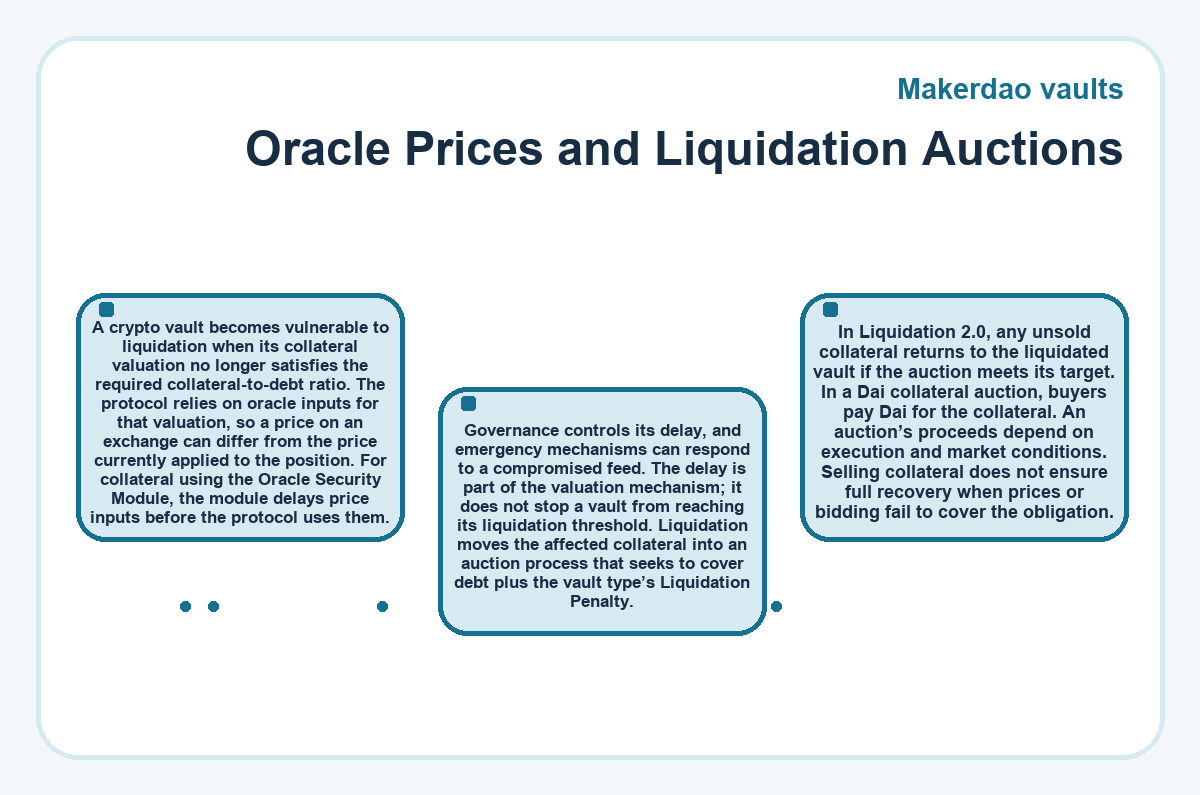
For collateral using the Oracle Security Module, the module delays price inputs before the protocol uses them. Governance controls its delay, and emergency mechanisms can respond to a compromised feed. The delay is part of the valuation mechanism; it does not stop a vault from reaching its liquidation threshold. Liquidation moves the affected collateral into an auction process that seeks to cover debt plus the vault type’s Liquidation Penalty. In Liquidation 2.0, any unsold collateral returns to the liquidated vault if the auction meets its target. In a Dai collateral auction, buyers pay Dai for the collateral. An auction’s proceeds depend on execution and market conditions. Selling collateral does not ensure full recovery when prices or bidding fail to cover the obligation.
MCD RWA Vaults and Offchain Obligations
Real-world asset (RWA) vaults in the historical Multi-Collateral Dai (MCD) model use approved operators and legal agreements, with different access and liquidation rules. RWA liquidation requires offchain recovery coordinated by governance and the deal’s participants, and can take months or years.
Approved Operators and the RWA Oracle
Governance creates these vaults and delegates their operation to approved counterparties. An RWA Token records the offchain asset for accounting, and the RWA Liquidation Oracle supplies the relevant valuation. That oracle updates when required under governance control, rather than following the ordinary crypto price-feed model. Legal documents govern how the operator uses the borrowed capital.
Fees and Payment Conduits
Some RWA arrangements separate onchain accounting from legally enforced interest payments. In RWA arrangements with legally defined fees, a zero onchain Stability Fee does not remove the offchain fee obligation. Specialized input or output conduits can handle required authorization or stablecoin conversion around drawdowns and repayments. Those arrangements belong to the particular deal.
SKY Borrowing and Morpho Yield Vaults
The current ecosystem also uses vault structures for SKY-backed borrowing and stablecoin lending strategies, each with different inputs and obligations. The Staking Engine, also called the LockStake Engine, accepts SKY and can secure an optional USDS loan. Its positions can also support staking rewards and governance delegation. Staking alone creates no USDS debt. The USDS loan has its own variable Borrow Rate, and collateral requirements limit withdrawal of the SKY securing it.
Sky Vaults deployed on Morpho accept the stablecoin each vault specifies and allocate it to lending strategies. Their suppliers receive exposure to a yield position, with withdrawals subject to available liquidity. A supplier’s Morpho vault position differs from a collateral owner’s Dai debt position. Selecting between them begins with whether the intended action is borrowing against an asset or supplying stablecoins to a strategy.
Makerdao vaults FAQs
Can I Fund a Dai Vault Repayment With USDS?
The Ethereum Dai-USDS converter exchanges USDS for Dai at 1:1, supplying the repayment asset for a Dai vault. The converter charges no protocol conversion fee; network gas remains separate. A USDS balance alone does not settle the vault’s Dai obligation.
Is an Empty Vault Deleted After Full Repayment?
An emptied Dai vault can remain available for a later deposit. Full repayment clears its debt, and withdrawing all collateral leaves an empty position. Reuse remains subject to the collateral and debt rules applying at the later deposit.
Does Holding MKR Still Give a Vote on Vault Risk Settings?
SKY has replaced MKR as the governance token, and MKR no longer carries protocol voting power. Collateral risk settings and protocol upgrades fall within that governance system. Holding a debt position is separate from holding governance tokens; a vault owner does not gain voting power merely by borrowing Dai.
Who Can See a Vault’s Onchain Position?
A vault’s transactions, collateral movements, and operating addresses appear in public blockchain records. Observers can examine its onchain activity and may connect wallet addresses to a person’s identity through transaction analysis. An address does not automatically reveal a name or make such identification certain.
Where Do RWA Fee Payments Enter Protocol Accounting?
For RWA arrangements using an RWA Jar, fees enter that accounting contract before moving into the Surplus Buffer. This accommodates offchain fee terms differing from ordinary onchain accrual. Transfers from the Jar to the Surplus Buffer can be permissionless once the fees have entered it.
Are MCD RWA Vault Tokens Redeemable or Freely Tradable?
The RWA Token in the historical Multi-Collateral Dai vault structure is an accounting representation without an independent redemption route. It is not freely transferable. Its role is to record the asset committed to the arrangement, so its presence in the vault does not give a holder a separately tradable claim.