 Makerdao
Makerdao: Starting USDS Savings With sUSDS
Updated onMakerdao became Sky in 2024, and its savings module accepts USDS to create an sUSDS position. The sUSDS shares accrue the variable, governance-set Sky Savings Rate through their USDS redemption value. Plain USDS sitting in a wallet does not earn this rate. Entry and redemption incur network gas costs, while sUSDS has no lockup period or cooldown. The savings position retains exposure to USDS collateral and peg risks.
USDS, sUSDS, and the Savings Contract
The savings contract accepts USDS, sUSDS represents the resulting shares, and the Sky Savings Rate determines how their redemption value accrues. USDS targets one US dollar and remains a transferable stablecoin. sUSDS uses ERC-4626, a tokenized vault standard expressing balances as shares of an underlying asset. Here, that asset is USDS. The savings contract holds the supplied asset, while the holder receives a token representing access to it and accrued savings.
The Sky interface provides access to those contracts from a browser. It does not set the savings rate or hold the wallet’s keys. Sky Governance sets the rate using protocol revenue and reserve considerations. The interface, the savings contract, and governance perform separate jobs within the same savings arrangement.
Prepare a First USDS Supply
A first USDS supply begins with a wallet balance available to the savings route and ends with sUSDS shares in the intended wallet. The Ethereum savings contract accepts USDS; an asset held on another network needs an appropriate supported route to reach that deployment. Network names and token balances alone do not establish compatibility. For a direct USDS supply, the quoted output uses the current USDS-per-sUSDS exchange rate. Equal numerical input and output amounts are not a requirement.
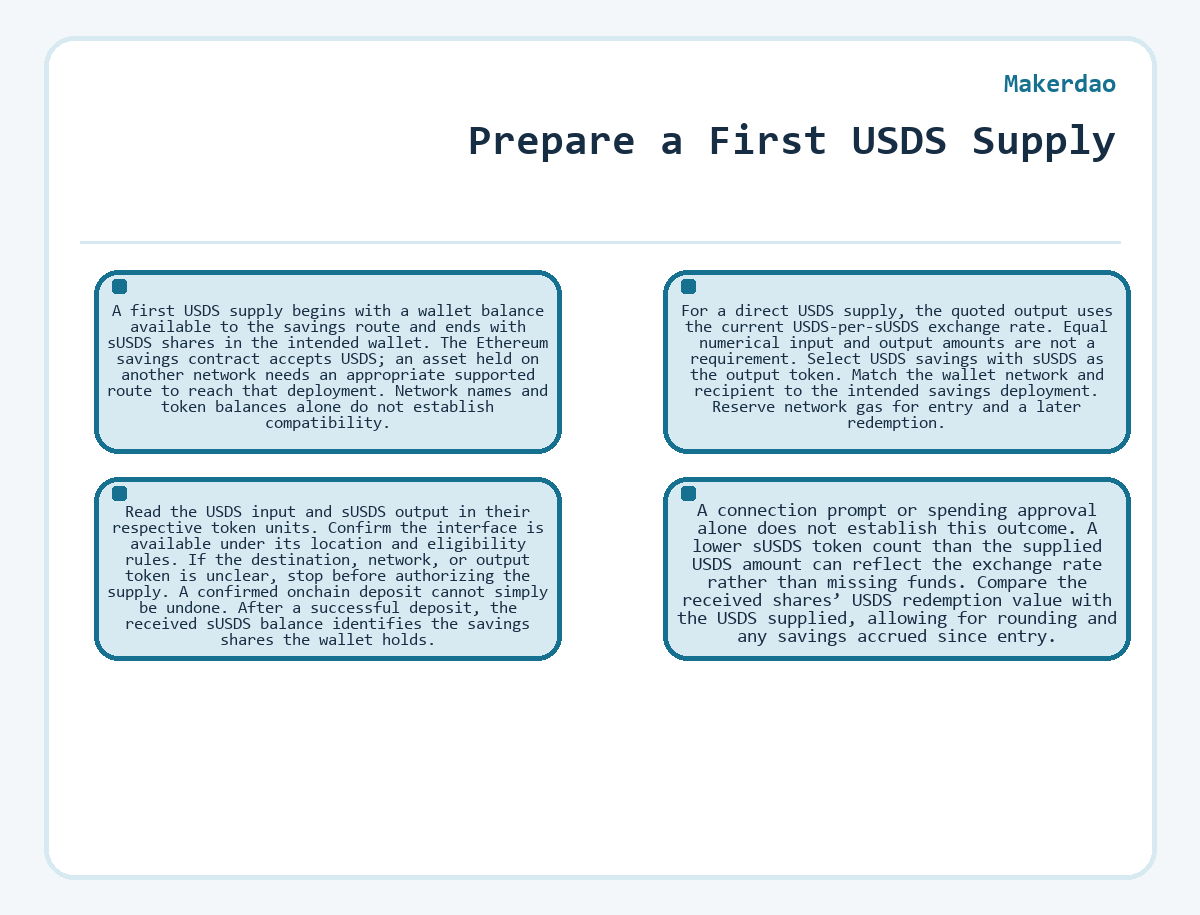
- Select USDS savings with sUSDS as the output token.
- Match the wallet network and recipient to the intended savings deployment.
- Reserve network gas for entry and a later redemption.
- Read the USDS input and sUSDS output in their respective token units.
- Confirm the interface is available under its location and eligibility rules.
If the destination, network, or output token is unclear, stop before authorizing the supply. A confirmed onchain deposit cannot simply be undone.
After a successful deposit, the received sUSDS balance identifies the savings shares the wallet holds. A connection prompt or spending approval alone does not establish this outcome. A lower sUSDS token count than the supplied USDS amount can reflect the exchange rate rather than missing funds. Compare the received shares’ USDS redemption value with the USDS supplied, allowing for rounding and any savings accrued since entry.
Why Does My sUSDS Balance Stay the Same?
An unchanged sUSDS balance is normal because savings accrue through each share’s USDS redemption value. The number of shares stays constant unless a deposit, transfer, or redemption changes it. A wallet displaying only token units may show no movement even while the USDS value changes.
The redemption value follows the share balance multiplied by the USDS-per-share conversion rate, subject to token precision and rounding. That relationship explains the savings balance without assuming sUSDS itself targets one dollar. A deposit changes the share count; accrual changes the conversion rate. Comparing balances across different moments therefore requires identifying which quantity changed. An annual rate displayed today also cannot establish the earnings for an earlier period when governance used a different rate.
The Sky Savings Rate can change while a position remains open, including falling to zero. A displayed annual rate therefore does not fix future earnings.
Protocol revenue funds the savings rate through a broader system than the savings contract alone. Sky Agents borrow USDS liquidity and deploy it into strategies including collateralized lending and US Treasury bill exposure. Payments back to the protocol contribute to its Surplus Buffer. Governance calibrates the savings rate against revenue and reserve targets. Holding sUSDS provides access to that protocol-wide rate; it does not give the holder direct ownership of a particular Agent’s strategy.
Gas and the Direct Savings Route
The direct USDS-sUSDS savings route charges no protocol fee for entry or redemption. Ethereum network gas remains payable, and congestion can raise that cost. A supported interface route can combine stablecoin conversion and savings entry in one transaction. Any exchange involved before entry or after redemption has its own pricing and costs.
Can I Redeem sUSDS Without a Waiting Period?
sUSDS has no lockup period, cooldown, or scheduled unbonding delay for redemption into USDS through the savings module. Redemption returns USDS at the share conversion rate when the transaction executes. That value includes the savings already accrued through the contract. There is no separate savings-reward claim to add after redemption. The amount returned in USDS and its dollar value remain different measures, especially if USDS moves away from its target.
Network confirmation and interface availability still affect how quickly a redemption completes. Congestion, transaction failure, or an interface interruption can delay access without creating a contractual waiting period. A partial redemption leaves the remaining shares in the savings position. Their redemption value continues to follow the applicable savings rate. The lack of a lockup does not promise uninterrupted access through every frontend.
The Backing Behind the Savings Balance
An sUSDS position rests on USDS, so its dollar value inherits the stablecoin’s collateral and peg risks. USDS draws backing from Protocol Collateral across stablecoins, lending positions, and real-world asset exposures. Their composition and values can change. A positive savings rate does not remove a loss caused by a depeg, weak collateral, or a smart-contract failure. The USDS-per-share conversion describes the savings claim; it does not fix the dollar price received on another market.
Contract and governance changes can affect the savings position alongside its underlying backing. The savings contract is upgradeable, and protocol governance can change parameters affecting the position. A vulnerability, faulty upgrade, or disruption in connected infrastructure can limit access or cause loss. Non-custodial ownership assigns signing control to the wallet. It does not supply an operator who can reverse a mistaken transaction. The recipient and network selected for the first supply therefore need attention before signing.
Other Stablecoin Positions and Their Exit Conditions
stUSDS funds USDS loans backed by staked SKY, linking suppliers to a specific borrowing activity. Its rate combines a component derived from the SKY Borrow Rate on utilized capital with the Sky Savings Rate on unused capital. Full redemption can require waiting when lending utilization is high. Suppliers also carry first-loss exposure if collateral liquidations do not cover the debt. These lending conditions distinguish stUSDS from the ordinary sUSDS savings position.
Sky Vaults deployed on Morpho follow their own lending strategies and liquidity constraints. They are separate from the sUSDS savings contract, even when their underlying markets use a Sky token as collateral.
Fixed Yield uses Pendle positions represented by PT-sUSDS to lock in a market-priced rate to a maturity date. Achieving that rate requires holding to maturity, subject to the underlying protocols operating as intended. Selling earlier exposes the position to the prevailing market price and available liquidity. This is a different commitment from holding sUSDS while its governance-set savings rate changes.
Using sUSDS as collateral for a separate loan introduces that loan’s borrowing and liquidation rules. Those conditions do not arise from holding sUSDS alone.
Frequently asked questions about Makerdao
Can My Dai Balance Fund sUSDS Savings?
Dai can fund sUSDS savings through the Ethereum Dai-USDS converter. That converter supports 1:1 conversion in either direction with no protocol conversion fee. USDS is the underlying asset for sUSDS, so the stablecoin conversion and savings deposit are distinct operations. Network gas remains payable for onchain activity.
Is SKY Required When Supplying USDS for sUSDS?
Holding SKY is not a requirement for supplying USDS to receive sUSDS. SKY carries governance voting power, while the savings contract uses USDS as its underlying asset. SKY holders can change the savings rate through governance, so those decisions affect a savings position without requiring its holder to own SKY.
Does Transferring sUSDS to Another Wallet Reset Its Savings Value?
Transferring sUSDS between wallets on the same deployment preserves the shares’ USDS redemption value. Accrual follows the share conversion rate, so changing the wallet holding those shares does not start a new savings clock. A transfer changes ownership of the shares and remains an onchain action requiring recipient and network checks.
Are My sUSDS Savings Transactions Private?
sUSDS savings transactions create public blockchain records. Wallet addresses and transaction history remain visible, and analysis may connect that activity to an identity. The Sky interface also processes wallet and access-related data for screening. Keeping control of the signing keys does not make deposit or redemption activity anonymous.
Can a Different Interface Access the Same sUSDS Savings Contract?
The sUSDS savings contract can also be reached through another compatible frontend or direct contract interaction. Access is not exclusive to the Sky interface. A frontend must support the relevant deployment and token operations; network support and access terms can differ. Contract compatibility does not establish identical interface features.